
Tyne Tunnel Toll Payment Odds: How Likely Are Drivers to Pay on Time?
Every journey through the Tyne Tunnel comes with a simple obligation: pay the toll by the deadline.
For the overwhelming majority of drivers, that is exactly what happens. But when more than 1.7 million vehicles use the tunnels in a single month, even a small percentage of missed payments can translate into tens of thousands of unpaid passages.
So, what are the real odds of completing a Tyne Tunnel toll payment on time? Which months have produced the highest rates of non-compliance? And how much revenue is generated through Unpaid Toll Charge Notices?
We analysed figures published by Tyne Tunnels to find out.

The Headline Odds
The latest figures available at the time of analysis cover March 2026.
During that month, 1,761,781 vehicles travelled through the Tyne Tunnels and 97.99% of customers paid their toll on time. The recorded non-compliance rate was 2.01%.
Put into more familiar odds, that means approximately one in every 50 passages was recorded as non-compliant.
Alternatively, for every one non-compliant passage, there were roughly 49 passages where the toll requirements were met.
That makes paying successfully the overwhelming favourite—but the remaining 2.01% still represents a substantial number of journeys.
Applying the published rate to March’s traffic gives an estimated 35,400 non-compliant passages during the month. This is an approximation rather than an official count, but it illustrates how quickly a small percentage becomes significant when traffic volumes are high.
How the Odds Have Changed
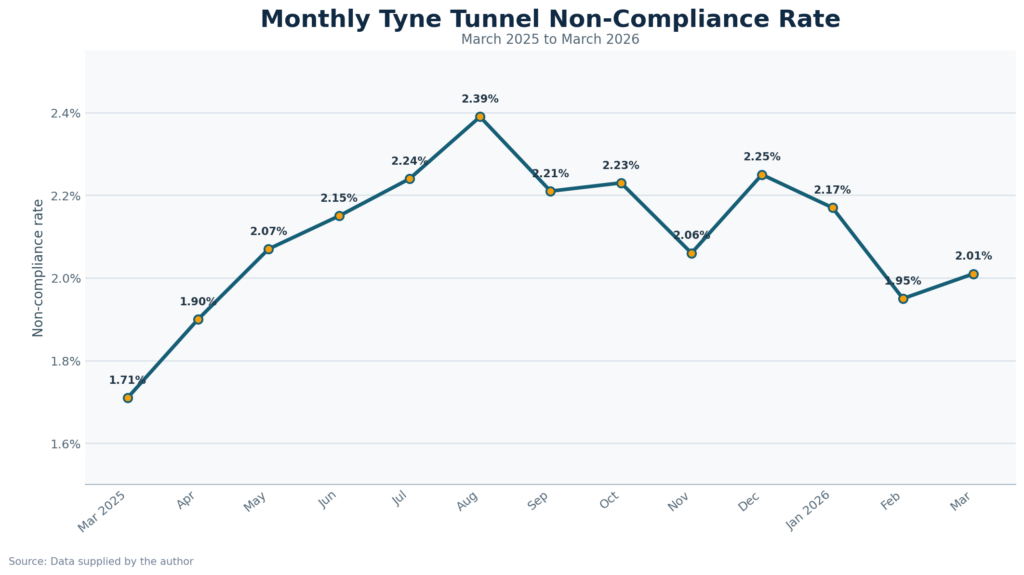
Tyne Tunnels publishes its non-compliance rate as a percentage of traffic. Across the 13-month period from March 2025 to March 2026, the figure remained between 1.71% and 2.39%.
| Month | Non-compliance rate | Approximate frequency |
|---|---|---|
| March 2025 | 1.71% | 1 in 58 passages |
| April 2025 | 1.90% | 1 in 53 passages |
| May 2025 | 2.07% | 1 in 48 passages |
| June 2025 | 2.15% | 1 in 47 passages |
| July 2025 | 2.24% | 1 in 45 passages |
| August 2025 | 2.39% | 1 in 42 passages |
| September 2025 | 2.21% | 1 in 45 passages |
| October 2025 | 2.23% | 1 in 45 passages |
| November 2025 | 2.06% | 1 in 49 passages |
| December 2025 | 2.25% | 1 in 44 passages |
| January 2026 | 2.17% | 1 in 46 passages |
| February 2026 | 1.95% | 1 in 51 passages |
| March 2026 | 2.01% | 1 in 50 passages |
The average across these monthly rates was approximately 2.10%. In simple terms, the typical odds of a passage being recorded as non-compliant were around one in 48.
The data also reveals a modest seasonal pattern. Non-compliance increased during the summer of 2025, reaching its highest point in August, before generally falling again.
However, the difference between the best and worst-performing months was less than one percentage point. The figures suggest that non-compliance is a persistent feature of the system rather than a problem confined to a particular time of year.
August Was the Unluckiest Month for Payments
August 2025 recorded the highest non-compliance rate in the period analysed, at 2.39%.
At that rate, approximately one in every 42 passages was non-compliant.
March 2025 produced the lowest rate, at 1.71%, equivalent to around one in every 58 passages.
This means a passage was approximately 40% more likely to be non-compliant in August 2025 than in March 2025.
There are several possible explanations. Summer can bring more irregular journeys, leisure travel and drivers who use the tunnels less frequently. Regular commuters may be more familiar with the payment system or have pre-paid accounts in place.
The published figures do not reveal why the rate changed, though, so seasonal travel patterns should be treated as a possible influence rather than a confirmed cause.
Does Non-Compliance Mean Someone Forgot to Pay?
Not necessarily.
It would be tempting to interpret every non-compliant passage as a driver simply forgetting about their Tyne Tunnel toll payment. In reality, there are several ways a payment problem can arise.
A driver may receive an Unpaid Toll Charge Notice if they do not pay within the permitted window. However, problems can also occur when a pre-paid account has insufficient credit or a vehicle has not been added to the account correctly.
An incorrect registration number can cause a payment to be associated with the wrong vehicle, too.
The statistics therefore tell us how frequently passages were considered non-compliant—not how many drivers deliberately avoided payment or genuinely forgot.
That distinction matters. One driver can make several passages, while one vehicle can potentially generate more than one notice. These are passage-level odds, not the odds of an individual person receiving a charge.
More Than 99% of Payments Are Digital
Tyne Tunnel toll payments are now overwhelmingly digital.
In March 2026, more than 99% of payments were made through digital channels. The published payment-method breakdown showed:
- 77.49% through the website or app
- 21.90% through automatic top-up
- A very small remainder through automated telephone payments and PayPoint
The figures show just how dependent the system has become on online and automated payment methods.
Web and app payments remain the dominant choice, but they still require a driver to take action. Auto Top-Up reduces that reliance on memory by automatically adding credit when an account balance becomes low.
This distinction could help explain why pre-paid and automated options are promoted so prominently. For a driver making regular journeys, removing the need to remember each individual payment substantially reduces the opportunity for human error.
Pre-Paid Accounts Have Become the Favourite
In the first year of the Tyne Pass free-flow system, 33% of customers used pre-paid accounts.
By March 2026, that figure had risen to 83.91%.
That is a dramatic change in driver behaviour. Pre-paid account usage has increased by more than 50 percentage points since the system’s first year.
The figure was even higher in January 2026, when 85.63% of customers used a pre-paid account.
It is important not to assume that pre-paid accounts guarantee successful payment. An account can still have insufficient credit, and a vehicle must be registered correctly. Nevertheless, the rise of pre-paid accounts means that most tunnel users are no longer approaching each journey as an isolated payment.
For regular travellers, that changes the odds considerably. The payment process becomes something managed in advance rather than a task that must be remembered after every crossing.
The £10.4 Million UTCN Question
The most striking statistic in the March 2026 dashboard concerns revenue.
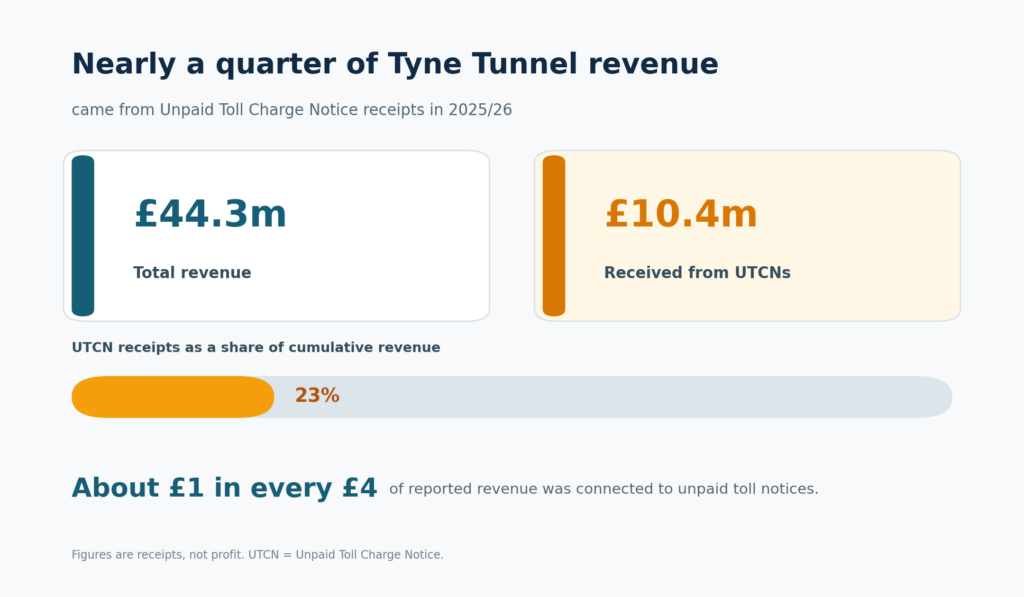
For the 2025/26 reporting period, Tyne Tunnels recorded cumulative total revenue of £44.3 million. That figure included £10.4 million in receipts from Unpaid Toll Charge Notices.
According to the dashboard, UTCN receipts accounted for 23% of cumulative revenue.
In other words, close to £1 in every £4 received during the stated period was connected to unpaid toll notices rather than ordinary toll payments alone.
This does not mean £10.4 million was pure profit. The published figure concerns receipts, and operating an enforcement system brings administrative, processing, correspondence and collection costs.
It also does not mean every UTCN was paid at its highest possible level. Some notices may be cancelled or successfully appealed, while others can progress through different stages.
Even with those qualifications, £10.4 million is a significant sum. It demonstrates the financial scale created when a relatively low non-compliance rate is applied across millions of journeys.
Why Missing a Small Toll Can Become Expensive
A standard toll is modest compared with the cost of allowing it to progress into an Unpaid Toll Charge Notice.
Drivers must pay by midnight on the day after their journey. If payment is not received in time, a UTCN can be issued with a £30 charge plus the original toll.
If the notice remains unpaid, the charge can increase. The published escalation process shows it rising to £60 plus the toll, followed by £100 plus the toll. A case passed to a third-party collection agency may attract an additional charge of up to £79.
The outcome is heavily weighted against waiting. A relatively inexpensive crossing can become a much larger bill, with no element of chance involved.
It is also important to know that making a normal toll payment after the original window has closed does not settle the missed passage. According to Tyne Tunnels, a late payment is instead applied to a future journey.
How Good Is a 97.99% On-Time Payment Rate?
A success rate of 97.99% sounds exceptionally high—and, viewed purely as a probability, it is.
If the same rate applied consistently, a randomly selected passage would be far more likely to comply with the payment requirements than not.
But percentages can disguise scale. At March 2026 traffic levels, every 0.1 percentage point represents approximately 1,762 passages.
Reducing non-compliance from 2.01% to 1.91% would therefore represent roughly 1,762 fewer affected passages in a month with comparable traffic.
A reduction of one full percentage point could mean approximately 17,600 fewer non-compliant passages.
This is why seemingly minor changes to payment reminders, account adoption or registration accuracy could have a sizeable effect.
Are Drivers Becoming More Reliable?
The short-term figures are mixed.
March 2026’s on-time payment rate of 97.99% was slightly lower than the 98.29% reported for March 2025. However, the March 2026 non-compliance rate of 2.01% remained comfortably below Tyne Tunnels’ stated target ceiling of 3%.
Across the period analysed, every monthly non-compliance result remained below that 3% target.
There was no uninterrupted movement in either direction. The rate climbed from 1.71% in March 2025 to 2.39% in August, then moved up and down before reaching 2.01% in March 2026.
The fairest conclusion is that payment performance has remained consistently high, but the underlying non-compliance rate has not disappeared.
How Drivers Can Improve Their Own Odds
The easiest way to avoid a UTCN is to remove as much reliance on memory as possible.
Occasional users can pay for their passage promptly through the official website or app rather than leaving it until the deadline approaches. Setting a phone reminder immediately after travelling provides a useful second line of defence.
Regular users may benefit from a pre-paid account with Auto Top-Up enabled. Vehicle registrations should be checked carefully, particularly after buying a new car, changing a number plate or using a different vehicle.
Drivers should also confirm that a payment has been completed successfully. Beginning the process is not the same as receiving confirmation that it has gone through.
Most importantly, anyone using the tunnels should check the current payment rules directly with Tyne Tunnels. Charges, deadlines and available methods can change.
The Final Verdict
The odds are firmly in the driver’s favour.
In March 2026, almost 98% of customers paid on time, while the non-compliance rate was approximately one passage in 50. Across the previous 13 months, the average was close to one in 48.
Yet the scale of Tyne Tunnel traffic means the minority still matters. A rate of around 2% can represent tens of thousands of passages, while UTCN receipts reached £10.4 million during the 2025/26 reporting period.
The real story is not that most drivers fail to pay. It is that a very small percentage, repeated across millions of journeys, can produce an unexpectedly large result.
For drivers, the lesson is straightforward: paying the toll is not something worth leaving to chance.
Methodology and Sources
This analysis uses monthly non-compliance rates published by Tyne Tunnels covering March 2025 to March 2026.
“One in X” figures were calculated by dividing 100 by the relevant non-compliance percentage and rounding to the nearest whole number. Estimated passage totals were calculated by applying a published non-compliance rate to the corresponding traffic figure.
These calculations are estimates and should not be interpreted as the number of individual drivers receiving UTCNs.
The primary sources were the Tyne Tunnels statistics archive, the March 2026 Customer Dashboard and the official UTCN guidance.